
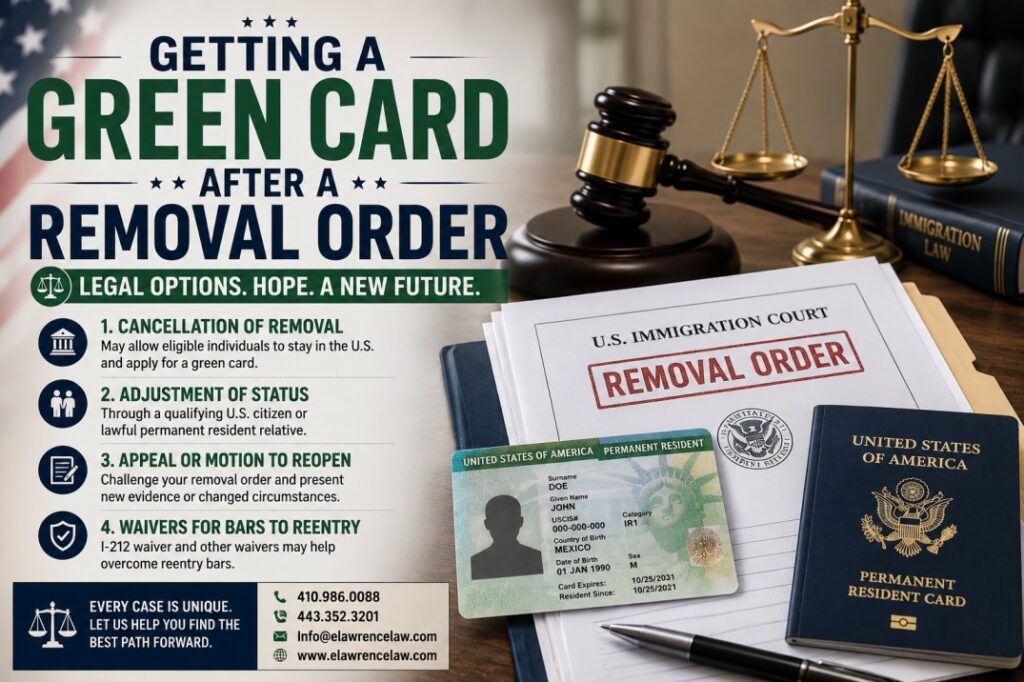
Having a removal (deportation) order does not permanently close the door to a green card, but the path is difficult and depends heavily on your specific circumstances. At the Law Office of Elizabeth Anu Lawrence, LLC. we zealously represent non-United States citizens during removal hearings.
1. Cancellation of Removal (Most Common Route)
This is the primary way people in removal proceedings can obtain a green card while still fighting deportation.
Eligibility requirements (non-LPR):
- You must have been continuously physically present in the U.S. for at least 10 years.
- You must show that your removal would cause “exceptional and extremely unusual hardship” to a spouse, parent, or child who is a U.S. citizen or lawful permanent resident — a very high standard.
- You must demonstrate good moral character and not have been convicted of certain crimes or violated certain laws.
- Even after meeting all those requirements, an immigration judge must exercise discretionary approval in your favor.
Annual cap & waiting list:
- U.S. immigration law sets an annual limit on approvals of cancellation of removal applications — immigration judges across the country can grant only 10,000 per year. (Some sources cite the effective number as closer to 4,000 for non-LPRs.)
- If the judge “reserves decision with intent to grant,” the formal approval cannot be issued until a visa number becomes available under the annual cap, which can result in a wait of one to two years or more.
- During this waiting period, you must avoid any conduct that would undermine a showing of good moral character, as this could result in the application being denied even after an initial intent to grant.
Getting the physical green card after approval:
- After you receive cancellation of removal, USCIS will receive a copy of your immigration file including the order granting cancellation, and the government attorney will give instructions for the next steps.
- In most cases, USCIS will create and mail your Green Card after the decision becomes final, typically without requiring additional in-person appearances.
- You should wait at least 45 days after the immigration judge’s or BIA’s order becomes final before contacting the USCIS Contact Center.
- At the Law Office of Elizabeth Anu Lawrence, LLC we are sure to follow up with USCIS after the Immigration court has granted approval.
2. Adjustment of Status Through a Family Petition
If you have a qualifying U.S. citizen or LPR family member, you may be able to adjust status even during removal proceedings.
- The first step is for a qualifying family member to submit Form I-130 (Petition for Alien Relative) to USCIS. Once approved, Form I-485 (adjustment of status) is filed with the immigration judge.
- Adjustment of status applicants must generally have entered the U.S. lawfully, unless they fall into an exception under INA Section 245(i).
- If you are seeking a green card based on a marriage that occurred after entering removal proceedings, you must meet a higher “clear and convincing evidence” standard to prove the marriage is valid.
3. Appeal or Motion to Reopen
If a removal order has already been issued, you may be able to:
- Appeal the decision to the Board of Immigration Appeals (BIA)
- File a Motion to Reopen the case if new evidence or changed circumstances exist (e.g., new family ties, new legal eligibility)
- Seek judicial review in federal court in the jurisdiction where you live.
These avenues can stop or undo a removal order and allow new relief applications to be heard.
4. Waivers for Bars to Reentry
A prior removal order creates bars to reentry (typically 10 years to permanent). If you’ve already been removed and are outside the U.S., you generally must:
- Obtain a Form I-212 (Permission to Reapply for Admission) to overcome the reentry bar
- Potentially file an I-601 Waiver for grounds of inadmissibility
- Then pursue a green card through consular processing
Key Practical Tips
- Always keep your address current with the immigration court using Form EOIR-33. You will not receive your green card if you do not keep the court notified of any address changes.
- Do not leave the U.S. while a cancellation case is pending, as this can break continuous presence and destroy eligibility.
- The immigration court system (EOIR/DOJ) and USCIS are separate agencies — winning relief in court does not automatically trigger USCIS action; you may need to follow up with both.
This area of law is extremely complex and fact specific. At the Law Office of Elizabeth Anu Lawrence, LLC. we evaluate your specific removal order, criminal history, family ties, and time in the US to identify your best options. Contact US on 410.986.0088, 443.352.3201 or via email: Info@elawrencelaw.com or schedule an appointment on Elawrencelaw.com