Archive for the ‘Family’ Category:

¿Quién puede solicitar derechos de visita o custodia de unmenor en Maryland?

La custodia de un menor en Maryland puede ser un asunto profundamente emocional, y no solo para los
padres del niño. Muchas personas creen que únicamente los padres legales pueden solicitar derechos de
visita y/o custodia — pero eso no es correcto.

En la Oficina Legal de Elizabeth Anu Lawrence, LLC, somos abogados con experiencia en derecho
familiar en Maryland y estamos aquí para ayudarle a hacer valer sus derechos.

¿Qué otras personas pueden solicitar la custodia de un menor?

Con frecuencia, los familiares extendidos desempeñan un papel fundamental en la crianza de un menor.
Por ejemplo, un tío o tía que acoge al menor cuando uno de los padres es enviado al extranjero, o un
abuelo que interviene cuando el padre o la madre está encarcelado.

Asimismo, los padrastros, madrastras o parejas de largo plazo de uno de los padres —aunque no hayan
adoptado legalmente al menor— pueden desarrollar vínculos duraderos que continúan aun cuando la
relación con el padre o la madre haya terminado. Todas estas personas pueden tener fundamentos para
solicitar custodia legal o derechos de visita del menor en Maryland.

¿Qué es un padre o madre de facto en Maryland?

Si usted no es el padre o la madre legal del menor, para solicitar la custodia deberá demostrar que es un
padre o madre de facto en Maryland. En términos sencillos, se trata de una persona que ha asumido el
rol parental en la vida de un menor.

Según la ley de Maryland (E.N. v. T.R., 474 Md. 346 (2021); Conover v. Conover, 450 Md. 51 (2016)), para
ser reconocido como padre o madre de facto debe demostrar lo siguiente:

  • Que los padres biológicos o adoptivos consintieron y fomentaron la formación de una relación
    parental con el menor;
  • Que usted y el menor vivieron juntos en el mismo hogar;
  • Que asumió responsabilidades parentales —cuidado, educación, desarrollo y manutención del
    menor— sin esperar compensación; y
  • Que desempeñó este rol durante un período suficiente para haber establecido un vínculo de apego
    y dependencia con el menor.

¿Qué significa esto en la práctica?

Deberá presentar pruebas ante el tribunal de que convivió con el menor y asumió un rol parental con el
consentimiento de los padres legales. Unas vacaciones de verano o algunos fines de semana en su hogar
casi con certeza no serán suficientes. Sin embargo, si ha vivido con el menor durante meses o años y ha
participado activamente en su crianza, podría ser reconocido como padre o madre de facto en Maryland.

Custodia de terceros en Maryland

Incluso si no cumple con los requisitos para ser considerado padre o madre de facto, es posible que pueda establecer derechos de custodia o visita como tercero en Maryland. En estos casos, el tribunal
normalmente dará prioridad a los deseos de los padres legales. Sin embargo, si puede demostrar que los
padres legales no son aptos para el cuidado del menor o que existen circunstancias excepcionales, podría
obtener custodia y/o derechos de visita.

¿Cuáles son sus próximos pasos?

Si desea solicitar la custodia o derechos de visita de un menor en Maryland, consulte con un abogado
de derecho familiar en Maryland para conocer sus opciones, costos estimados y tiempos del proceso.
Comuníquese con la Oficina Legal de Elizabeth Anu Lawrence al 443-352-3201 o al 410-986-0088 para
programar una consulta hoy mismo.

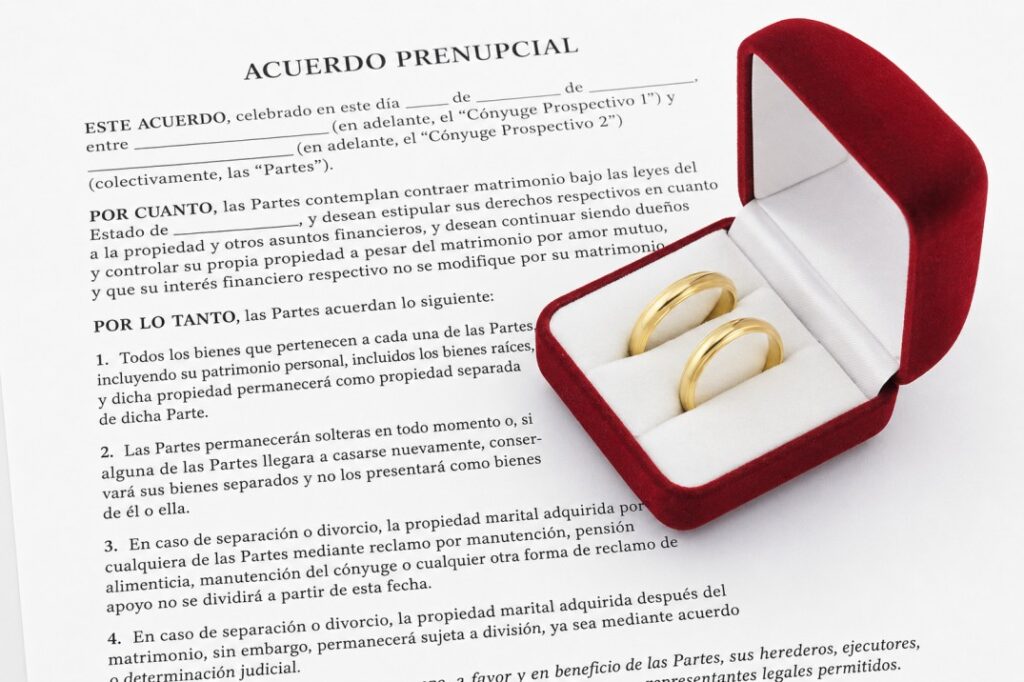
¿Necesita un acuerdo prenupcial en Maryland? Lo que debesaber antes de casarse

¡Felicidades por su compromiso! Si está planeando casarse, es posible que se pregunte si un acuerdo prenupcial en Maryland es adecuado para usted y su futuro cónyuge. Aunque puede parecer un tema incómodo, un acuerdo prenupcial —también conocido como acuerdo antenupcial en Maryland— puede proteger a ambas partes y establecer una base sólida para el matrimonio. 

¿Por qué necesitaría un acuerdo prenupcial en Maryland? 

Muchas personas pasan por alto los acuerdos prenupciales porque creen que son exclusivos para personas de altos ingresos. Sin embargo, un acuerdo antenupcial puede ser una decisión inteligente independientemente del nivel de ingresos. 

Por ejemplo, supongamos que el Cónyuge A tiene dos abuelos vivos que poseen una hermosa cabaña en el área del Lago Deep Creek. Los abuelos desean que el Cónyuge A y sus dos hermanos hereden la propiedad. Aunque su valor económico no es elevado, está llena de recuerdos familiares. Si bien la propiedad heredada en Maryland generalmente no se considera conyugal, un acuerdo prenupcial puede aclarar que el Cónyuge B no podrá reclamarla en caso de divorcio, reduciendo así costos e incertidumbre. 

Otro ejemplo: si ambos cónyuges desean tener hijos y el Cónyuge B planea quedarse en casa para criarlos, el acuerdo prenupcial puede establecer que, en caso de divorcio, el Cónyuge B recibirá una compensación económica por cada año que no trabajó fuera del hogar. Esto garantiza equidad y permite que ambas partes inicien el matrimonio con confianza. 

Estos son solo algunos ejemplos de las razones por las cuales las personas optan por un acuerdo prenupcial. Si usted tiene preguntas sobre su situación específica, un abogado de derecho familiar en Maryland puede ayudarle a determinar qué tipo de acuerdo es el más adecuado. 

¿Cuáles son los requisitos para un acuerdo prenupcial válido en Maryland?

Un acuerdo prenupcial legalmente ejecutable en Maryland debe cumplir con los siguientes requisitos: 

Tiempo suficiente 

No es posible firmar un acuerdo prenupcial camino al altar. Los tribunales de Maryland pueden considerar que los acuerdos firmados demasiado cerca de la fecha de la boda fueron realizados bajo presión. Es fundamental dejar suficiente tiempo antes de la ceremonia para negociar los términos, redactar el documento y firmarlo. 

Representación legal independiente 

Un acuerdo prenupcial en Maryland es un contrato legal que debe ser redactado por un abogado. Además, es indispensable que cada parte cuente con su propio abogado de derecho familiar en Maryland para revisar el acuerdo de forma independiente y asegurarse de que sus intereses estén protegidos. 

Divulgación financiera completa 

Ambas partes deben declarar la totalidad de sus activos, deudas y pasivos. La falta de divulgación financiera en acuerdos prenupciales puede invalidar el documento ante un tribunal. 

Equidad al momento de la firma 

El acuerdo debe ser justo para ambas partes en el momento de firmarse. Un acuerdo en el que una parte recibe todos los activos y la otra queda sin nada difícilmente será ejecutado por un tribunal de Maryland. 

¿Cuáles son mis próximos pasos? 

If you wish to obtain a prenuptial agreement in Maryland , consult with a licensed Maryland family law attorney to learn about your options and associated costs. Contact us at the Law Office of Elizabeth Anu Lawrence through Elawrencelaw.com or call 443-352-3201 to schedule a consultation today.

I’m Getting Married! Is a Prenuptial Agreement Right for Me?

Congratulations on your engagement! It may seem like everybody in your life is coming out of the woodwork to offer you advice, but did you know that a prenup, or prenuptial agreement may be a good fit for you and your future spouse?

At the Law Office of Elizabeth Anu Lawrence, LLC.,  we are experienced family law litigation attorneys, and happy to help you prepare a Prenuptial Agreement that protects you in the event of a divorce.

Congratulations on your engagement! It may seem like everybody in your life is coming out of the woodwork to offer you advice, but did you know that a prenup, or prenuptial agreement may be a good fit for you and your future spouse?

At the Law Office of Elizabeth Anu Lawrence, LLC.,  we are experienced family law litigation attorneys, and happy to help you prepare a Prenuptial Agreement that protects you in the event of a divorce.

Why Would I Need a Prenuptial Agreement?

Many people overlook prenups (also called antenuptial agreements in Maryland), because they don’t think they are the kind of person who needs one. But a prenup can be a good idea, regardless of income level.

For example, say that Spouse #1 has two living grandparents who own a beautiful old cabin in the Deep Creek Lake area. The grandparents intend for Spouse #1 and their two siblings to inherit the cabin—the property isn’t worth much, but it’s a spot for treasured family memories. While inherited property is usually non-marital, a prenup can help clarify that Spouse #2 can’t make any claim for the cabin in a divorce proceeding, cutting down on costs and uncertainty later.

Another example: Both spouses want children, and they expect that Spouse #2 will be a stay-at-home parent and raise the children. In order to keep things fair and to compensate Spouse #2 for their hard work, the parties agree in their prenup that if they divorce, Spouse #2 will receive $5,000 for each year they did not work outside the home. Preplanning this issue helps Spouse #2 feel valued and financially secure and allows both parties to feel confident that they are entering the marriage as financial equals. 

These are just a fraction of the many reasons that people may choose to have a prenup—a family law attorney can help you explore your personal situation and what kind of prenup may be right for you.

What are the Requirements for a Prenup?

A legally enforceable prenuptial agreement requires all of the following:

  1. Sufficient time. You cannot sign your prenup on your way to the altar. A prenup is a legal document, and Maryland courts may find prenups signed too close to the wedding date to be coerced. Make sure to leave plenty of time before the wedding to get the prenup terms agreed upon and the document drafted, finalized and signed.
  2. An attorney for both parties. A prenup is a legal contract, so you should always retain an attorney to draft the document, but it is very important that both parties retain separate counsel. Each party’s lawyer will have the opportunity to review the document, talk through all pros and cons, and make sure that their client is protected.
  3. Financial disclosure. Both parties must disclose all assets, debts and liabilities.
  4. Equitable at the time signed. The prenup agreement must be fair to both parties at the time it was signed. For example, a provision that one spouse walks away with 100% of the assets and the other walks away with nothing is clearly unfair and is very likely to be unenforceable by the Court.

I’m Interested in Obtaining a Prenuptial Agreement—What Are My Next Steps?

If you are interested in obtaining a prenuptial agreement, you should consult with a licensed Maryland family law attorney so that you can understand your options, as well as the potential costs and time frame. Please contact the Law Office of Elizabeth Anu Lawrence, LLC. at Elawrencelaw.com or call our office on 410-986-0088 or 443-352-3201 in order to schedule a consultation today.

Who Can Pursue Visitation Rights for a Child?

Child custody can be a very emotional issue, and not just for the parents of the child. People often believe that only the legal parents of a child may pursue visitation and/or custody, but that isn’t true!

At the Law Office of Elizabeth Anu Lawrence, LLC.,  we are experienced family law litigation attorneys, and happy to help you enforce your visitation rights.

Which Other Individuals May Be Able to Pursue Custody?

Oftentimes, extended family members may be deeply involved in raising a child, such as an aunt or uncle who takes in the child when the parent is deployed overseas, or a grandparent who steps in when the parent is incarcerated. Stepparents and long-term romantic partners of a parent, even those who have not adopted the child, may also form lasting and loving relationships that persist even when the romantic relationship with the parent is over. These individuals may all have a case for establishing legal custody and visitation rights with the child.

If you are not the legal parent of a child, in order to pursue custody you must prove that you are a de facto parent of the child.

What is a De Facto Parent?

A de facto parent is, simply put, a person who has acted in the role of a parent for a child. In Maryland, in order to be considered a de facto parent, you must prove the following:

  • That the biological or adoptive parent(s) consented to, and fostered, the formation and establishment of your parent-like relationship with the child;
  • That you and the child lived together in the same household;
  • That you assumed obligations of parenthood by taking significant responsibility for the child’s care, education, and development, including contributing towards the child’s support, without expectation of financial compensation; and
  • That you have been in a parental role for a length of time sufficient to have established a bonded, dependent relationship with the child.

 E.N. v. T.R., 474 Md. 346 (2021); Conover v. Conover, 450 Md. 51 (2016).

What does this mean?

It means that you must show evidence to the Court that you lived with the child and stepped into a parental role for them, with the consent of the child’s legal parent(s). You must also have lived with/bonded with the child for a significant amount of time—a summer trip or a few weekends spent at your house are almost certainly not sufficient. But if you have lived with the child for months or years and been an active participant in raising them, you may be considered a de facto parent.

Third Party Custody

Even if you don’t meet the criteria for a de facto parent, you may be able to establish custody and visitation rights in certain circumstances. If you are not a parent or de facto parent, you are likely a third party—and the Court would normally prioritize the legal parents’ wishes over those of a third party. However, if you are able to prove that either the legal parents are unfit or that exceptional circumstances exist, you may be able to obtain custody and/or visitation of the child. 

What Are My Next Steps?

If you are interested in pursuing custody or visitation of a child, you should consult with a licensed Maryland family law attorney so that you can understand your options, as well as the potential costs and time frame. Please contact the Law Office of Elizabeth Anu Lawrence, LLC on 443.352.3201 or 410.986.0088 in order to schedule a consultation today.

PENDENTE LITE HEARINGS IN MARYLAND

Divorce, custody, separations, and child access issues could be challenging, long and daunting for most people. The court process in Maryland is usually a long process between when a Complaint is filed and the conclusion of the divorce case. Parties may need a temporary resolution from the court to resolve immediate issues regarding child access, alimony, and day to day needs before the final resolution of the divorce case.

(more…)

Understanding How Child Support is Calculated in Maryland

Maryland is one of many states that has set guidelines for how child support is awarded. The Child Support Guidelines are designed to help ensure equity and fairness and make sure that children have the financial support that they need to thrive. When you are potentially going to be paying or awarded child support, it’s important that you understand how the payment is calculated.

(more…)

3 Financial Mistakes You Should Avoid During a Divorce

Getting a divorce can be an incredibly stressful, emotional situation. Unfortunately, that can lead you to do things and make decisions that you would not normally make otherwise. Working with an attorney is one way to make sure that you are doing things that are the best for you and your family. What are some of the financial mistakes that individuals make during the divorce process?

(more…)

What Are My Legal Rights as Birth Parent of an Adopted Child?

When considering moving forward with the adoption process, it’s obviously important to have a crystal-clear understanding of your rights as a prospective parent. To help you understand whether adoption is the best choice for you and your family, we will outline key rights you will have as the birth parent of an adopted child.

(more…)

How Is the Child Support Obligation Calculated in Maryland?

When an individual is going through a divorce, there are many personal and financial details that must be ironed out between each partner before the split is finalized. When couples with children are preparing to split, one of those critical details is child support logistics. Both parents are required to support their children after divorce in the state of Maryland, but how is child support obligation actually calculated?

(more…)

What are the Most Common Financial Mistakes Made During Divorce?

Divorce is a nuanced, and often lengthy process that will ultimately lead to the dissolution of your marriage. After the dust settles, the last thing you’ll want to discover is that a financial mistake or oversight could affect your financial situation for years to come. As such, let’s go over the most common mistakes individuals make throughout the divorce process.

(more…)